The idea of microcosm and macrocosm is threading across the majority of religious and philosophical traditions, regardless of their structure and origin. From East to West, from North to South, this is a theme that repeats itself. The most famous, probably, is the Hermetic saying "as above so below", that refers to this same principle. It basically comes to say that the world around us is reflected in us, and we are reflected in the world. On any level of organisation of any given system we can find similarities that are subject to universal laws. The way a cell behaves is not so different in essence from the way the whole organism does, and upon close examination we can find many parallels of this kind.
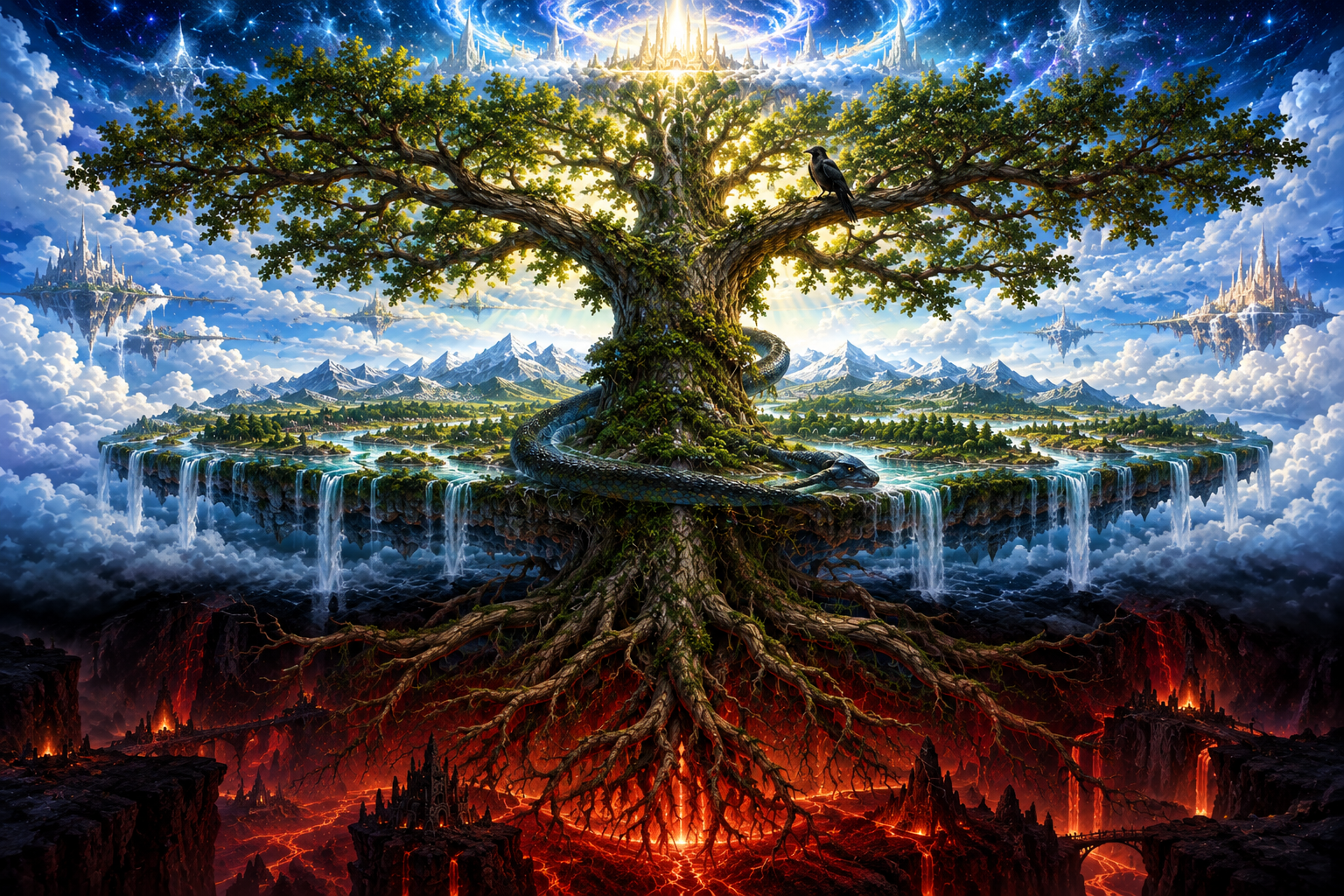
One such idea that can be universally applied to almost anything on any level is the existence of a certain axis around which a thing is organised. We can find the mention of this concept in almost all major religions. Axis mundi is a common theme among all known shamanic traditions from Siberia to South America and it is reflected often in the practices that involve climbing a tree or some other tall object as a form of initiation. Amongst the Yakuts, climbing the birch tree as part of the initiatory rite of the shaman is a very common practice. The tree of life itself is a common theme and a known symbol in Hinduism, Buddhism, Taoism, and most pagan religions that we know of, the most famous being the Scandinavian Yggdrasil. The Christian symbol of a cross represents it accurately enough so that we can safely say that it migrated from the older belief systems into Christianity through syncretism. There is a tree of life of Eden, central to all three Abrahamic religions, as well as the cosmic tree that unites Earth and Heaven.
In the human body, we cannot clearly point at a specific structure and say: this is the axis. It can somewhat be placed where the actual spine is, and usually this is how it is described, but that would be too simplistic and, for anyone who has actually examined the way that the body moves, not accurate. The central axis of the body across which most of our movement is organised does not really correspond to anything we can clearly point at on the anatomy chart. It is an imaginary abstract line that crosses various structures of the body, and it changes depending on the situation. However, when you have mapped it through practice its presence becomes very clear inside the body, both when you move and in stillness. The experience is very clear when you have it.
Finding the axis and mapping it inside the body is necessary if we want to move well; I would say it is one of the primary things that will affect everything else. Knowing where it is equals knowing where you are in space, and sensing how the relationship of the axis to gravity changes determines how well we orient ourselves. Without the sense of axis, it would be really hard to properly organise our movement, and this is exactly what is happening to most people who do not know how to use their body. These are the people we call awkward or uncoordinated, people who have no proper control of their own structure in space. The main issue with them is that they cannot perceive where they are; without a strong central axis the body is just a blob that is dragged around almost passively. In sports like wrestling or grappling, that involve body-to-body contact, controlling your opponent's axis gives you a huge advantage, and you cannot do it without knowing how to manipulate your axis first. In partner acrobatics and contact improvisation, in order to sustain another person's weight you need to be able to stabilise it very well; same with punching and throwing mechanics. The list can go on indefinitely.
This concept does not only relate to the actual physical movement, but also to knowing deeply who we are and our place in the world in a more metaphysical sense. In the English language we say that a person is "spineless", referring to their inability to firmly stand their ground, to being easily pushed around. It is the same in Russian, German, French, Japanese, and many other languages. Although not universal, it is common enough to hint at a specific relationship of relating the existence of an axis or lack of it to the ability of a person to stand for themselves, have courage to do things or, conversely, completely lack moral character. In Spanish they say "he has no blood", for example, but they also have a saying "centrate", translating literally as "get yourself around the centre", when they want to tell someone to gather their focus. The sense of knowing who you are is tightly connected to knowing of the centre, because without it there is no place you can anchor yourself to. When the axis is there, you stand firmly on the ground; you know where you are and, most importantly, who you are.
Just like in the Biblical stories and in the shamanic rites, where the axis mundi connects the higher and the lower, our internal axis is a way to pin down the different parts of ourselves that are hard to reconcile. It is said in many traditions that humans are a link between the divine and material, that we have the capacity to be in both worlds and this is what makes us different from the rest of the animals. In many Sufi sects and some other religious currents they believe that humans are not born with a soul, but a soul is something that you create by your actions in this world. They believe that you are given the opportunity by coming to this life, and then it is up to you to take it or not. This translates to building "the spine", "the backbone", "the centre". It makes sense if you think about it: you come to this world amorphous, and you have a chance to build a ladder for yourself to ascend through your own actions and through your own choices, and this will pass through the centre of your being and either build it up or destroy it. It is a necessary step for elevating ourselves. It is a line that connects different parts of ourselves in a strictly physical sense, but that also connects us to reality in a completely different way. It is the micro and the macro. Without it we cannot travel higher, we cannot reach our full potential, and we are condemned to stay the same, to live life without a chance of deeper knowledge. It is in our hands, thus, to build the axis and to connect Heaven and Earth through it. And the only way to do it is through practice.